Do you ever see a beautiful scene, take out your camera, take the shot and then wonder what went wrong? Why doesn’t the display on the LCD screen look at all like the scene in front of you?
Do you ever stand next to another photographer and wonder how they made an image that is better than the scene you see with your own eyes?
Understanding how the camera “sees” is the key to figuring out why this happens and what you need to do to take charge of your camera and make the images you envision.
If you’re already dreading the mathematical calculations, don’t worry! I’m not going to start measuring my eyeballs and pupils and trying to figure out what kind of lens my eyes are equivalent to in focal length, f/stops, and ISO, or how many megapixels my eyes see. That’s not what this is about.
It’s just about understanding how a camera works differently than our eyes.
When the camera’s “eye” is better than our own
Sometimes the best images show the very thing that we cannot see with our own eyes.
Low Light Levels
At low light levels our eyes are less sensitive to colour than normal. Camera sensors, on the other hand, always have the same sensitivity. That’s why photographs taken in low light appear to have more colour than what we remember.
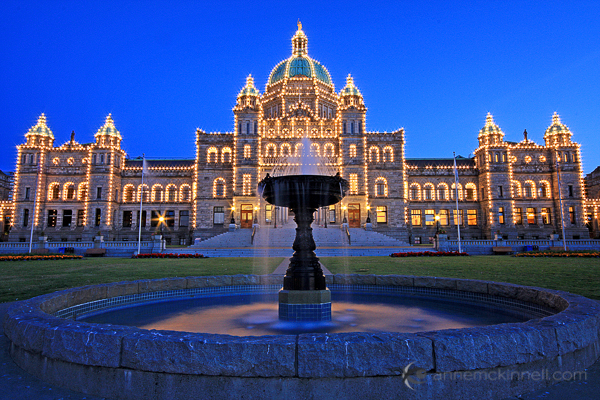
When I made this image of the Legislature in Victoria, British Columbia, the sky was much darker and less blue to my eye.
Long Exposures
The longer the shutter remains open the more light can enter the camera and hit the sensor. Therefore long exposures can bring out objects that are faint in the sky whereas our eyes will perceive no extra detail by looking at something longer.
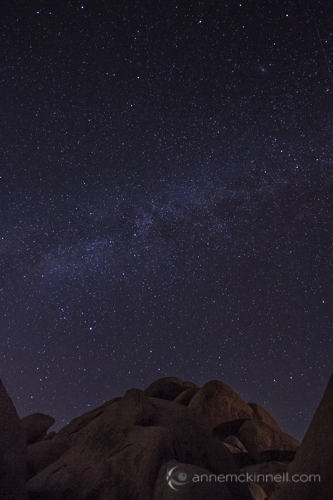
The 30 second exposure in this image, made at Joshua Tree National Park in California, picked up more stars than I could see with the naked eye.
Long exposures also allow us to see the passing of time in a way we cannot with our eyes.
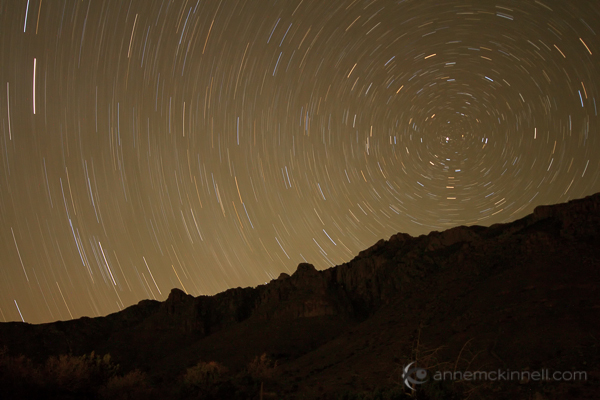
In Guadalupe National Park, Texas, I was able to capture the movement of the stars around Polaris, the north star, by leaving the shutter open for 30 minutes.
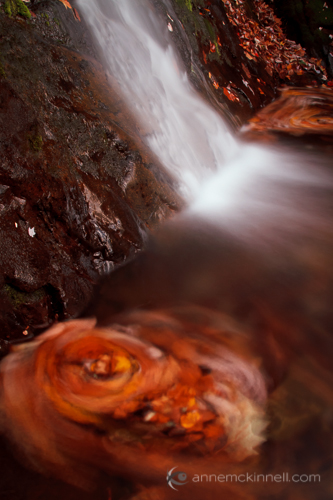
At Fallingwater Cascades along the Blue Ridge Parkway in Virginia, the movement of the water caused the maple leaves to swirl around in a circle. By using a 15 second exposure I was able to capture the movement of the leaves.
Short Exposures
On the other end of the scale, high speed photography can freeze motion and allow us to see something that would otherwise pass by too fast for our eyes to retain any detail.
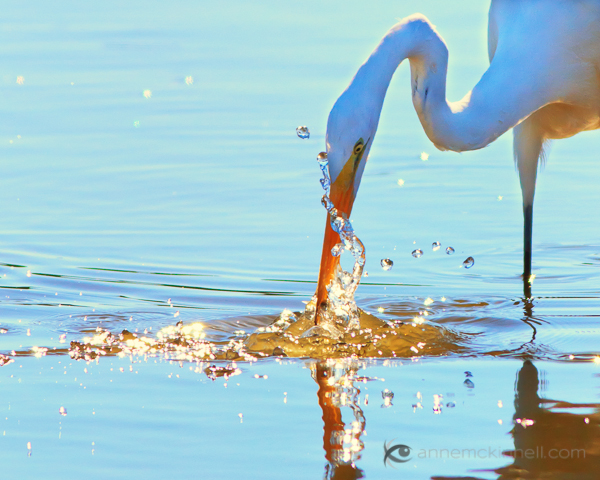
By using a shutter speed of 1/5000 second, I was able to freeze the water droplets as they swirled around the egret’s beak as he caught a fish.
Depth of Field
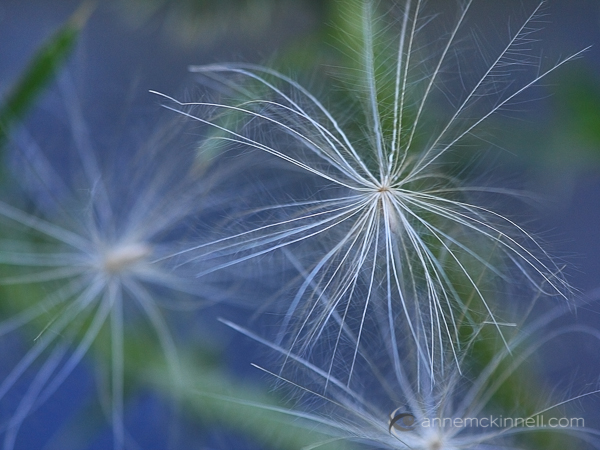
One thing that is somewhat similar between a camera and a human eye is aperture, but only if you hold it steady. For example, if you stare at one word in the middle of the this sentence and do not move your eyes, you can perceive that the other words are there but they are not clear. The part that is in focus is only the centre portion of your field of view.
That is the same as a camera with a small aperture. The difference is that you can’t actually look at the out-of-focus part. As soon as your eye moves to the out-of-focus words they instantly become in-focus.
Whereas if you are looking at a print or an image on your screen you can look at the out-of-focus part which is something we cannot do with our eyes. That’s why shallow depth of field images are so interesting to us.
Colour
Most of us see in colour. Others see limited colours. But either way we are stuck with what we have. Maybe that’s why some people like or dislike black and white photography. For a long time colour was considered a limitation in photography and the human eye was obviously better. But now photographs give us the option of viewing things in a different way.
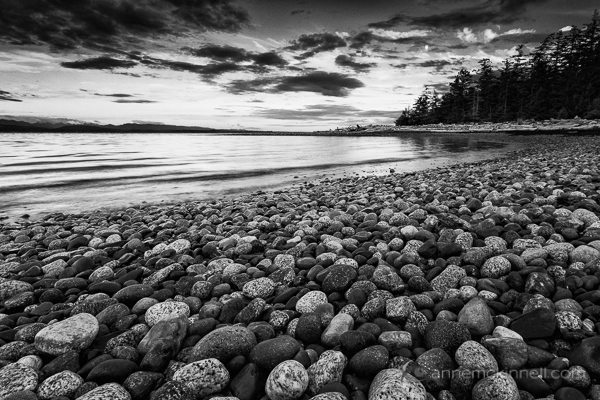
Rocks on the beach at Rebecca Spit, Quadra Island, British Columbia.
When the human eye (or brain) is better
Dynamic Range
One thing to keep in mind is that when we see something with our eyes, our brain is involved too. Think of optical illusions where you perceive something that isn’t actually there.
As we look around a scene our eyes quickly adjust to changing light. Take a scene with dark shadows and bright highlights for example. As your eye moves from one area to another it quickly adjusts so our eyes take in the right amount of light and we see detail in all parts of the scene. When we look at a scene it is like our brain takes numerous snapshots and what we perceive is the combination of those snapshots.
Your camera cannot do that. It simply records the light that hits the sensor at one aperture setting. It can only have one exposure for the whole scene.
That is where exposure blending, or high-dynamic-range (HDR) photography, can sometimes make a scene look more like what we perceived at the time.
On the other hand, depending on how you blend your images, HDR photographs can show us a lot more detail than what our eyes saw and then they don’t look realistic. Not that there’s anything wrong with that! It depends on whether you want your images to be realistic or not.
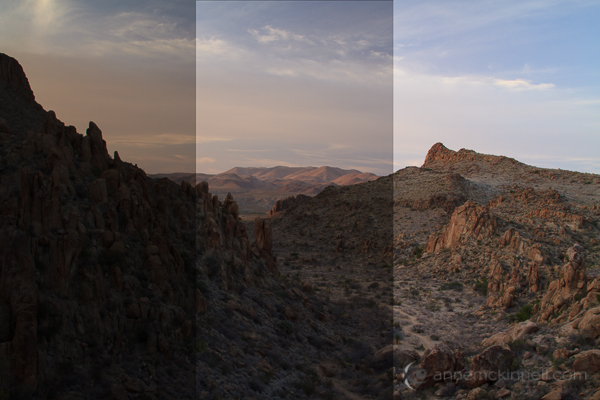
The image above represents the same scene taken at three different exposures. One exposure is for the shadows, another for the mid-tones and the other for the highlights.
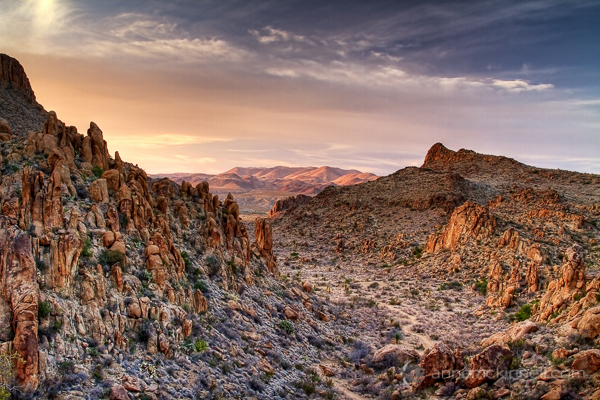
Grapevine Hills, Big Bend National Park, Texas.
I can blend those images together in photoshop and end up with an image like this. Our brain does that all by itself!! This more closely represents the image I remember in my mind.
Conclusion
The kinds of images that are considered good differ from person to person. It’s subjective.
Some people like images that are just like what their eyes saw or are capable of seeing — the realistic images.
Other people prefer images that show them what they cannot see such as black and white, long exposures, or HDR with tons of detail.
Either way, understanding why the camera “sees” things differently than you will put you well on your way to creating the kind of images you want to make.
Post originally from: Digital Photography Tips.
Check out our more Photography Tips at Photography Tips for Beginners, Portrait Photography Tips and Wedding Photography Tips.
Why does your camera see things differently than you?
via Digital Photography School http://digital-photography-school.com/why-does-your-camera-see-things-differently-than-you?utm_source=feedburner&utm_medium=feed&utm_campaign=Feed%3A+DigitalPhotographySchool+%28Digital+Photography+School%29
The issues you have raised are very important. Because it is important to keep these things in mind while photographing. Your photography has been nice. If the pictures could be edited, it would be more very beautiful.
ResponEliminaThank you so much sharing for your valuable information.
background removal service
transparent background Photoshop