Passa al contingut principal

Creative Color Processing (Part 2/3 – Split Toning)

This is Part 2 of a 3-part series on creative color effects using Lightroom 4. In Part 1 of the series, I discussed shifting White Balance either warmer or cooler for creative effect. In this article I will explain Split Toning, and also give you some ideas for using creative white balance and split toning together for even more color control.


For this image, I used split toning to complement the autumn foliage by adding red to the shadow areas:
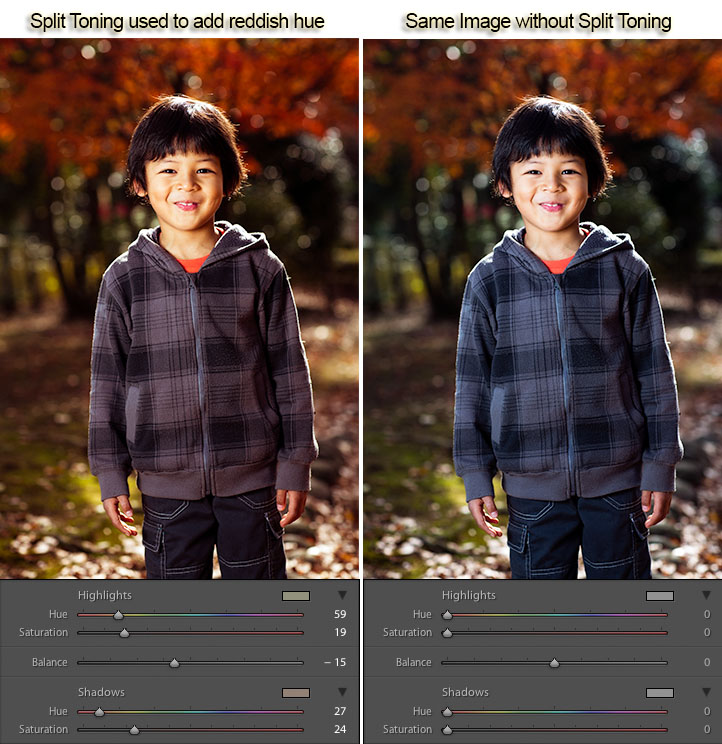

Split toning used to add a warm reddish hue

Example of Split Toning used to add a reddish hue


While white balance affects the entire image, split toning allows you to treat the shadows and highlights differently. You can add one color to the shadows and a different color to the highlights, and also control the balance between the two.


In processing this scene of a street in Tokyo I used split toning to add blue to the shadows and yellow to the highlights:
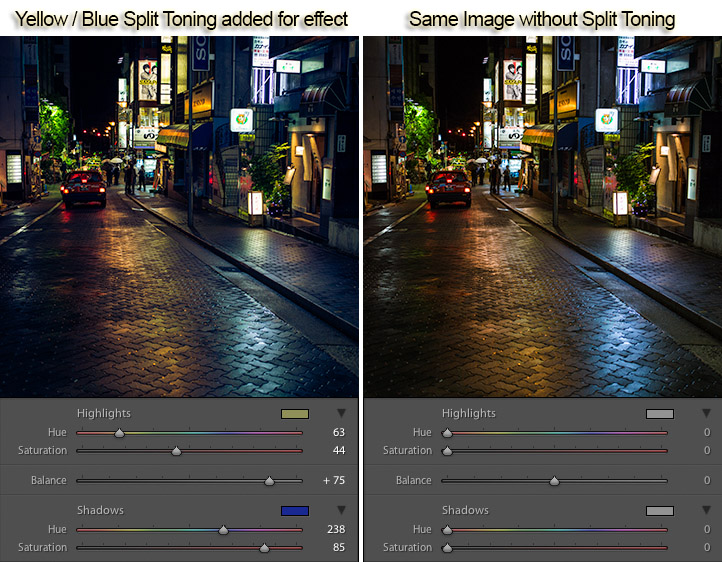

Example of Split Toning

Example of Yellow / Blue Split Toning


Split Toning can also be combined with white balance for creative effect. In the photo below I used a cool 3500 kelvin white balance, and then used split toning to warm the skin tones by adding yellow to the highlights. The result is cool-toned image, without unnaturally bluish skin tones. In this way, white balance and split toning can be used together to create an effect that would not be possible with either tool on its own.
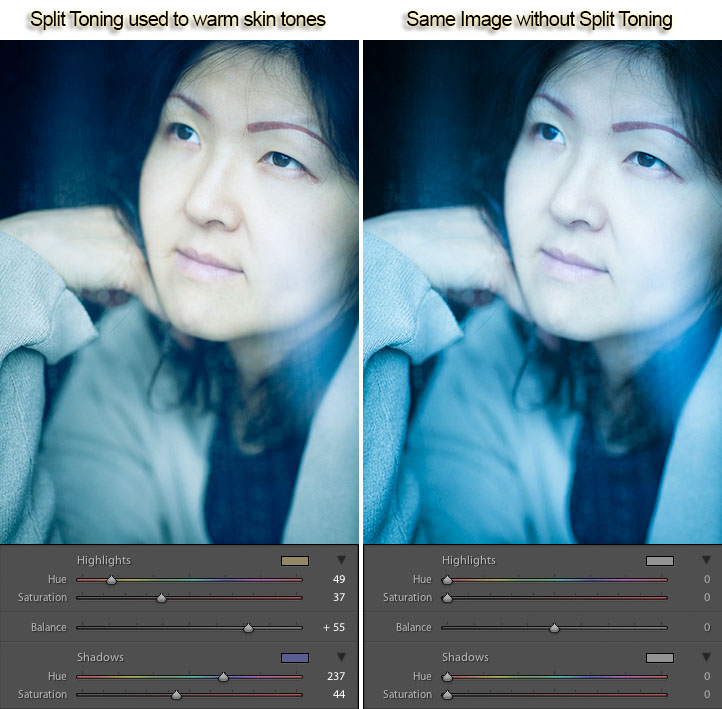

Split toning to warm skin tones

Using Split Toning to warm skin tones


Creative color processing is very subject, and ultimately comes down to personal preference. Even if you don’t really like the editing decisions I’ve made in these sample photos, I hope I’ve inspired you to try some new techniques for creatively processing your photos. I appreciate feedback, please comment below or feel free to connect with me through Facebook or Google+.


This concludes Part 2 of my Creative Color Processing series. In Part 3, I will show you how to use the Tone Curve tool to control the red, green, and blue color channels separately.


Post originally from: Digital Photography Tips.


Check out our more Photography Tips at Photography Tips for Beginners, Portrait Photography Tips and Wedding Photography Tips.


Creative Color Processing (Part 2/3 – Split Toning)


via Digital Photography School http://digital-photography-school.com/creative-color-processing-part-23-split-toning?utm_source=feedburner&utm_medium=feed&utm_campaign=Feed%3A+DigitalPhotographySchool+%28Digital+Photography+School%29

Comentaris

  1. Your information is very valuable which is useful for me. I wish you all the best. Thank you so much.

    transparent background Photoshop

    ResponElimina

Publica un comentari a l'entrada

Entrades populars d'aquest blog

Learn Composition from the Photography of Henri Cartier-Bresson

“Do you see it?” This question is a photographic mantra. Myron Barnstone , my mentor, repeats this question every day with the hopes that we do “see it.” This obvious question reminds me that even though I have seen Cartier-Bresson’s prints and read his books, there are major parts of his work which remain hidden from public view. Beneath the surface of perfectly timed snap shots is a design sensibility that is rarely challenged by contemporary photographers. Henri Cartier-Bresson. © Martine Franck Words To Know 1:1.5 Ratio: The 35mm negative measures 36mm x 24mm. Mathematically it can be reduced to a 3:2 ratio. Reduced even further it will be referred to as the 1:1.5 Ratio or the 1.5 Rectangle. Eyes: The frame of an image is created by two vertical lines and two horizontal lines. The intersection of these lines is called an eye. The four corners of a negative can be called the “eyes.” This is extremely important because the diagonals connecting these lines will form the breakdown ...

El meu editor de codi preferit el 2024, que això ja se sap que va canviant 😄

Visual Code Visual Code és un editor de codi font lleuger, però potent que s’executa al teu escriptori i està disponible per a Windows, macOS i Linux. Compta amb suport integrat per a JavaScript, TypeScript i Node.js i té un ric ecosistema d’extensions per a altres llenguatges i entorns d’execució (com C++, C#, Java, Python, PHP, Go, .NET).  És una eina ideal per a desenvolupar i depurar aplicacions web i en el núvol. Per què Visual Code? Visual Code té molts avantatges com a editor de codi font, com per exemple: És gratuït, ràpid i fàcil d’instal·lar i actualitzar. Té un ampli ecosistema d’extensions que et permeten afegir funcionalitats i personalitzar la teva experiència de desenvolupament. Té un suport integrat per a molts llenguatges i entorns d’execució, i et permet depurar i executar el teu codi des del mateix editor. Té una interfície senzilla i elegant, amb diferents temes i modes de visualització. Té un sistema de sincronització de configuracions que et permet guardar les...

Las Mejores Aplicaciones Gratis para iPad de 2012

Las Mejores Aplicaciones Gratis para iPad de 2012 : ¿No tienes ni un duro? No te preocupes, pues hoy os traemos una extensa selección de las mejores apps gratuitas que puedes conseguir en la App Store para que llenes tu iPad de calidad, sin gastar nada de nada.   ¿Estás buscando juegos o apps gratis para tu iPad? En la App Store hay más de 500,000 apps y juegos, y una gran cantidad de ellos está disponible de forma totalmente gratuita. Aquí vamos con la selección de las mejores Apps gratis para iPad (todos los modelos), organizada por categoría. ¿Estás preparado? Las Mejores Apps Gratis de Redes Sociales para iPad Nombre Facebook Gratis Categoría Redes sociales Facebook es la red social más famosa del mundo , con casi mil millones de usuarios. Su app para iPad ha tardado, pero aquí está. Nombre Twitter Gratis Categoría Redes sociales Twitter es la red de microblogging por excelencia. La forma más rápida y directa de informar y mantenerse informado de las cosa...